

The Chaldean Magi: Their Spiritual Role in Jesus’ Life

It’s a cold April day, after yesterday’s unexpected heat. The fireplace crackles softly as I cuddle under the covers, laptop set on the hearth. Earlier, I watched Miss Potter, a warm and nostalgic film that perfectly matched the comfort of the moment. Inspired by the quiet reflection of the day, I thought I’d share something I wrote about this morning for my upcoming book—about the Chaldean Magi, their connection to Jesus, and the profound mystery that surrounds their story.

The Magi are often shrouded in a sense of wonder. Described in the Gospel of Matthew as the “wise men from the East,” they followed the star to Bethlehem, bringing gifts of gold, frankincense, and myrrh to honor the newborn Christ. But their story doesn’t end there. Tradition and history link the Magi to the Chaldeans, an ancient priestly class known for their wisdom in astrology, divination, and spiritual practices.

The Magi and Their Role in Jesus’s Story

The Magi’s connection to Jesus is both spiritual and deeply symbolic. After visiting the Christ child, they were warned in a dream not to return to King Herod. Herod, furious at being deceived by the Magi, ordered the massacre of all male children in Bethlehem under the age of two—a tragic event remembered as the Feast of the Holy Innocents. By taking another route home, the Magi not only defied Herod’s evil plans but also played a role in safeguarding Jesus during his vulnerable early years.

But how did the Magi, coming from a non-Christian tradition, recognize the significance of Jesus’s birth? The answer lies in their spiritual heritage.

The Chaldean Magi: Guardians of Ancient Wisdom

The Magi were often associated with the Chaldeans, a people renowned for their mastery of the stars and their ability to interpret divine messages. The Chaldeans’ reputation as wise men and astrologers was so enduring that their name became synonymous with knowledge and mysticism in many ancient texts.

The Magian religion, tied to Zoroastrianism, emphasized the battle between light and darkness—a theme that resonates deeply with the Christian story of salvation. The Magi tended sacred fires, interpreted dreams, and acted as mediators between the divine and the earthly. These roles made them uniquely attuned to the signs in the heavens, such as the star that heralded Jesus’s birth.

Tradition even suggests that after their visit to Bethlehem, the Magi passed through Chaldean villages, celebrating the miraculous birth and planting seeds of faith. Centuries later, these seeds would bloom as Christianity spread to the region.

The Enduring Legacy of the Magi

The story of the Magi is not just a tale of three wise men bringing gifts; it is a profound reminder of how faith and wisdom transcend boundaries. These ancient sages recognized Jesus as the light of the world long before Christianity had fully developed. Their journey symbolizes the universal call to seek truth and to honor the divine, no matter one’s background or tradition.

Writers throughout history, from the priest Berossus to Helena Blavatsky, have marveled at the Magi’s connection to the Chaldeans. Blavatsky, for instance, described the Chaldeans as guardians of mystical and occult sciences, linking them to the broader tradition of the Magi. Their knowledge of the stars and their role as interpreters of divine will gave them a unique place in history as bearers of wisdom and truth.

A Path Illuminated

As I reflect on the story of the Chaldean Magi, I’m struck by their courage and faith. They risked everything to follow a star and honor a child they knew to be extraordinary. Their defiance of Herod’s orders reminds us of the power of choosing righteousness over fear. And their role in protecting Jesus reminds us of the interconnectedness of faiths, traditions, and history.

On this quiet April day, I’m reminded that the Magi’s story is not just about the past. It’s about the ongoing journey we all take to seek light, wisdom, and truth in our lives.

So as the fire crackles and the rain begins to fall outside, I leave you with this thought: What stars are we following today, and how might the wisdom of the past guide us on our own journeys?
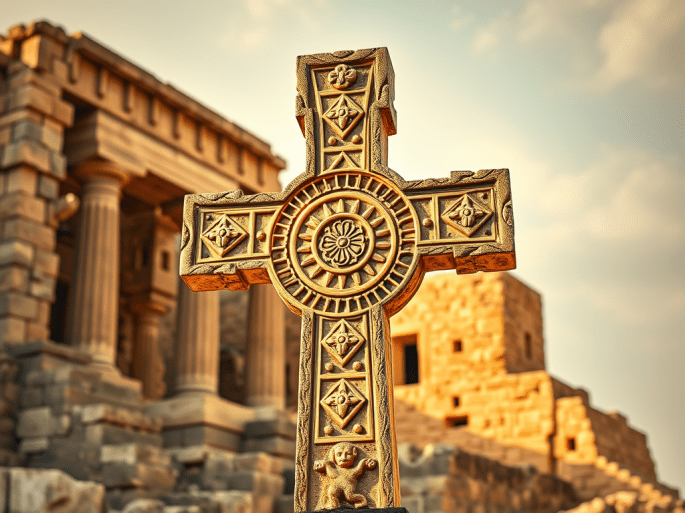
The Cross: From Chaldea to Christianity

While working on the second book in my series, The Magical Museum, which explores the faith and Church history of the Chaldeans, I stumbled upon a fascinating fact: the sacred symbol of the cross, central to Christian culture, significantly predates Western religion. As a Chaldean, I find it remarkable that this symbol, so integral to my faith, also holds deep historical roots in my ancestors’ culture. The 11th edition of the Encyclopedia Britannica puts it plainly: “The cross has been used both as a religious symbol and as an ornament from the dawn of man’s civilization.” This symbol appeared across ancient cultures—from Scandinavia to Egypt—and played a particularly prominent role in the spiritual culture of Chaldea, a civilization that flourished from 612 to 539 B.C.

The Cross in Chaldea

Ancient Chaldea, located in what is now southern Iraq and Kuwait, was one of the central cultural and spiritual hubs of the Middle Eastern world. Under the Chaldean Dynasty, rulers such as Nebuchadnezzar II rebuilt Babylon into a cultural and religious center. It was in this rich environment that the cross emerged as a symbol of spiritual significance.

The Chaldean cross began as a circular sun symbol, representing the rays of the sun—a source of life and renewal. Over time, two beams crossed the circle, symbolizing the sun’s rays and marking one of the earliest recorded uses of a two-beamed cross. Eventually, the Chaldeans removed the circle, leaving only the intersecting beams. This design evolved to represent the four cardinal points of the sky, a concept deeply tied to Chaldean cosmology.

Historian G. Maspero, in History of Egypt: Chaldea, Syria, Babylonia and Assyria, speculates that the two-beamed cross may have also symbolized a man standing upright with arms outstretched. This imagery, with rounded protrusions at the ends resembling fingers, suggests that the cross was not only a cosmological symbol but also a representation of humanity’s connection to the divine.

A Symbol of Rebirth

In Chaldea, the cross was closely associated with Tammuz, the sun god and husband of the goddess Ishtar. Tammuz was celebrated as a deity of fertility, renewal, and life. The Chaldeans honored him with a six-day festival at the start of the summer solstice, marking a time of rebirth and abundance. Interestingly, Tammuz’s name lives on today as the month of July in Iraqi Arabic, Levantine Arabic, the Chaldean calendar, and the Jewish calendar. Tammuz is the month of the sin of the golden calf, which resulted in Moses breaking the tablets of the Ten Commandments. References to Tammuz even appear in Arabic literature from the 9th to 11th centuries AD.

This theme of rebirth resonates strongly with Christian beliefs. The crucifixion and resurrection of Jesus Christ transformed the cross from an instrument of suffering into a symbol of redemption and eternal life. Both ancient Chaldean practices and Christian theology highlight the cross as a bridge between the physical and spiritual realms, representing renewal, transformation, and hope.

The Cross’s Evolution and Legacy

The cross’s journey from Chaldea to Christianity reflects the way symbols can evolve while retaining their spiritual essence. By the time of Emperor Constantine in the 4th century A.D., the cross had become a central symbol of the Christian faith. While it had once been an instrument of execution, Constantine’s vision of the cross as a sign of victory transformed its meaning.

This shift mirrors the overarching narrative of Christianity: the power of God to redeem what is broken and bring forth new life. The cross, rooted in ancient history, became a unifying symbol for believers, transcending time and culture.

Embracing the Cross’s History

As a Chaldean, I feel a profound connection to the journey of the cross. Its ancient origins in the culture of my ancestors remind me that faith is a thread woven through the tapestry of history, uniting humanity with the divine across time and place. Acknowledging these origins deepens our understanding of the cross’s significance in Christianity, showing how God’s presence has always transcended cultural and historical boundaries.

The spiritual practices of ancient civilizations highlight a universal longing for connection with the divine—a longing beautifully fulfilled in the life, death, and resurrection of Jesus Christ. By exploring these historical roots, we gain a richer appreciation of the cross not only as a symbol of faith but also as a testament to God’s eternal love and grace.

Conclusion

The cross has traveled an incredible journey, from its origins in ancient Chaldea as a sun symbol to its central role in Christianity as a sign of hope and redemption. Its history is a testament to humanity’s enduring relationship with the spiritual realm and our shared desire for renewal and connection with the divine.

Exploring the cross’s history allows us to embrace it as part of God’s grand narrative. The cross is not just a relic of the past but a living symbol that continues to inspire faith, hope, and love in the present.

If you’d like to dive into the first book of The Magical Museum series before the second installment is released, it’s the perfect time to embark on this journey through Chaldean faith and history. Stay tuned for more fascinating discoveries in the upcoming book!

Interview with Ahmed Al Mamoori, Archaeologist & Director of Basrah Museum

Ahmed Al Mamoori is an archaeologist and is the Director of Basrah Museum, housed in a former palace of Saddam Hussein. Ahmed is the inspector of antiquities responsible for relations and negotiations with landowners and other interested parties. He oversees the survey and inspections of sites and monuments in preparation of the new Basrah Museum.

He received his education at Babylon University with a BA in Ancient Archeology. In 2019, he became director of Basrah Cultural Museum. His publications include The Architectural Styles of the Church of Mar Gurgis, Erbil published in the Daily Newspaper in 2018. Ahmed has received additional training for the maintenance of cultural heritage during a course in Beijing, and he has participated in several archaeological fieldworks at the University of Manchester, the University of Wales, and other institutions.